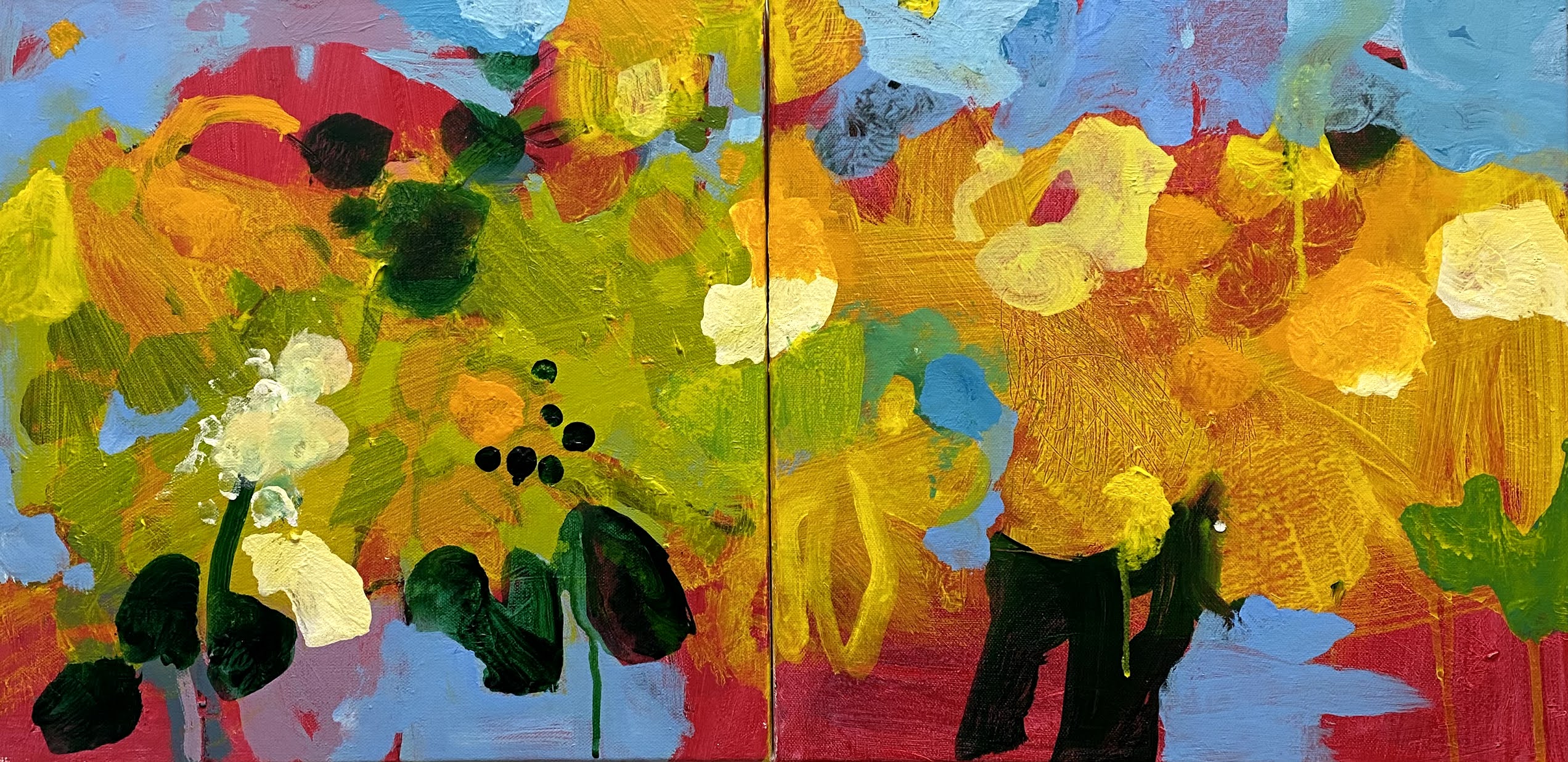
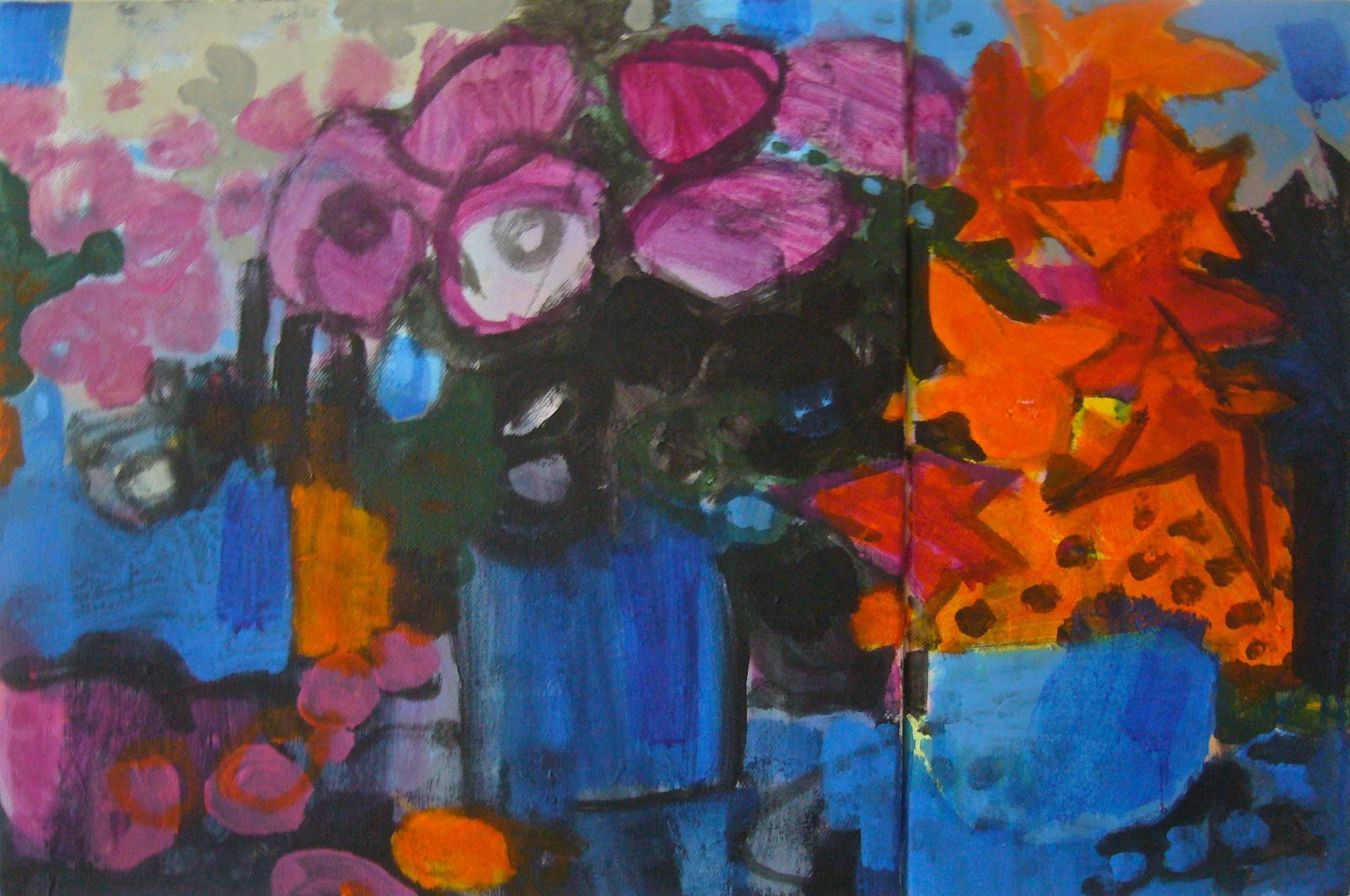
47/ Triptyque, Triptychon, acrylique sur toile, acrylic on canvas, Acryl  auf Leinwand, 2011, 0,40 x 1,00 m, 2012 *


45/ Triptique, Triptychon,  acrylique sur toile, acrylic on canvas, Acrylic auf Leinen 0,40x1,20 m *
44/ Diptyque, Diptychon, acrylique sur toile, Acrylic auf Leinen, acrylic on linnen, 0,80 x 0,40 m, 
 15,7x47,2 in 
44 b/Yellow Asters, 1,00 x 1,00m 40 x 40 inches, 2011


Le Vertige des Fleurs


Pierre Charras

La peinture est comme la vie, belle et terrifiante.
Parfois, on ne sait plus laquelle imite l'autre. On est debout au bord d'une plage, au soleil. C'est beau. Et pourtant la peur vous prend aux épaules. Car il n'y a pas que l'image, il y a aussi le bruit des vagues. Deux sens sollicités en même temps, ça vous donne le vertige.
C'est la même inquiétude qui vous saisit devant les fleurs de Marie Theres Berger. Parce qu'on ne fait pas que les voir, ces fleurs, on les sent. On est tombé dedans, on est tombé. Il y a ces contours indéchiffrable, toutes ces couleurs sauvages; mais il y a aussi cette odeur enivrante des fleurs au printemps. L'odorat doit partager avec la vue. C'est un combat. La tête vous tourne.
Et le ciel? Ou est le ciel? Il n'y a pas de place pour lui dans ces grands formats. On est tout contre les bulbes; à hauteur des tiges, presque; si près des racines, de la terre. De la vie alors? Oui de la vie! Elle est là, veillée par la beauté. Et c'est ce qui nous pousse à regarder. Et nous restons là, interdits, captivés, fascinés. Car l'art sidère toujours; il n'y a aucun moyen de fuir, seulement celui de contempler une fragile beauté qui va s'abîmer.
C'est ce qui nous voulions, non? De l'éphémère. Mais nous espérons aussi que ça durera. La peinture n'est pas autre chose: l'éphémère qui dure.
Cette beauté va-t-elle se faner, se corrompre? Ca ne peut pas tenir, des fleurs.
Ca ne peut pas tenir? Celles-ci, peut-être. Et si elles étaient là pour nous guérir de la mort?
Ne semblent-elles pas protégées par un film? Sont elles sous l'eau? Les voit-on à travers une vitre? A travers nos larmes?
On ne sait plus. Nous y revoilà. Nous avons cessé d'être sereins. La peur est de retour. Elle nous attire contre elle et nous aimons son étreinte. Encore un vertige. Encore notre cœur qui bat.
Les images de Marie Theres Berger sont comme nos fragiles vies. Allons les frôler de nos regards, la narine palpitante. Et ne boudons pas l'ivresse qui va nous saisir.


Floral Vertigo
Pierre Charras
Painting is like life, beautiful and terrifying.
Sometimes it's hard to know who is imitating who. You are standing on the edge of a beach in the sun. Everything is fine. Nontheless fear grips you. It's because there is more to it than the picture; there is the sound of the waves. It is a simultaneous appeal to two senses; that's what makes you dizzy.
It's the same unease we experience in front of Marie Theres Berger's flowers. We don't just see these flowers of hers; we smell them. We are amongst them. There are indecipherable contours, wild colours. But there is also that intoxicating scent of spring flowers. Smell must cohabit with vision, but there is conflict. It makes our heads spin.
And where's the sky? There is no room for it in these large canvases. We are close to the bulbs, the stems , so near the roots and the earth. To life itself perhaps? Yes, it is there, watched over by all this beauty. And that's what compels us to look, and we keep on looking, transfixed, captivated, fascinated. Art invariably stuns. There is no escape, only the contemplation of this fragile beauty which must spoil.
Isn't that what we wanted, the ephemeral? But we hope paradoxically that it will last. After all, that is what painting is: the ephemeral becoming permanent.
Will this beauty fade? And decay? Flowers can't last; it's not possible. But these perhaps. What if they were there to cure us from death? Don't they seem to be protected by a transparent film, or are they under water? Are we looking at them through glass? Or through our tears?
No way of knowing. Here we are again. Our serenity gone. Fear is back. We are attracted to its familiar embrace. Vertigo and a pounding heart again.
Marie Theres Berger's pictures are like our fragile lives. Let's let our gaze wander over them, our nostriles finely tuned. And let us not resist the intoxication which will invade us.
Translation Oliver Bevan

2011

43a/ Diptyque, Diptychon, huile sur toile, oil on canvas, Öl auf Leinwand, 1,70 x 1,90 m, 2011 *
Triptyque
43/ Triptyque, Triptychon, huile sur toile, oil on canvas 0,55 x1,60 m 


42/ Poliptyque, Poliptychon, huile sur toile, oil on canvas 0,90 x 1,20 m *


Ölpastelle 2011


36/ 37/ 38/ 39/ 40/ 41/  0,50 x 0,70 m


Carrés, Squares, Quadrate 2010

35/ "Rouge II" acrylique sur toile, acrylic on canvas, Acryl auf Leinwand, 1,00x1,00 m, 40x40 in

34/ "Bleu II" acrylique sur toile, acrylic on canvas, Acryl auf Leinwand, 1,00x1,00 m, 40x40 in 

33/ "Jaune II" acrylique sur toile, acrylic on canvas, Acryl auf Leinwand,1,00 x 1,00 m, 40 x 40 in
32b/ acrylique sur toile, acrylic on canvas, Acryl auf Leinwand, 1,00 x 1,00 m, 40 x 40 in *32/ "Bleu I", acrylique sur toile, acrylic on canvas, Acryl auf Leinwand, 1,00 x 1,00 m, 40 x 40 in

2010

31/ "Un bol d'air", diptyque, Diptychon, acrylique sur toile, acrylic on canvas, Acryl auf Leinwand,1,70 x 2,00 m, 67 x 78 in *
30/ "Chatting with Bill I", Diptyque, Diptychon, acylique sur toile, acrylic on canvas, Acryl auf Leinwand, 0,30 x 0,60 m
29/ "Chatting with Bill II", Diptyque, Diptychon, acylique sur toile, acrylic on canvas, Acryl auf Leinwand, 0,30 x 0,60 m

2009

28/ "Nach dem Regen" Triptyque, Triptychon, acrylique sur toile, acrylic on linnen, Acryl auf Leinwand, 0,80 x 2,40 m, 31,4 x 94,5 in
            27/ "Carré Bleu", huile sur lin, oil on linnen, Öl auf Leinen, 1,60 x 1,60 m, 63 x 63 in *

26/ "Grand Carré", huile sur lin, oil on linnen, Öl auf Leinen, 1,95 x 1,95 m, 76,8 x 76,8 in *
26b/Poliptyque, Poliptychon, huile sur toile, oil on canvas, Öl auf Leinwand, 2006, 1,30 x 3,90 m *

25/ "Rotes Quadrat" huile sur lin, oil on linnen, Öl auf Leinwand, 1,00 x 1,00 m, 39,4 x 39,4 in *
                              24/  "Germantown", Diptyque, Diptychon, 0,40 x 0,80 m - 31,5 x 15,7 inches

23/ "Petrol",huile sur lin, oil on linnen, Öl auf Leinwand, 1,00 x 1,00 m, 39,4 x 39,4 in


22/ Diptyque, Diptytchon, huile sur toile, oil on canvas, Öl auf Leinwand 0,60 x 1,20 m
23,6 x 47,2 in

   
21/ Triptyque, Triptychon, acrylique sur toile, acrylic on canvas, Acryl auf Leinwand, 0,50 x 1,20 m,19,7 x 47,2 in


20/  Diptyque, Diptytchon, huile sur toile, oil on canvas, Öl auf Leinwand 0,60 x 1,20 m
23,6 x 31,5 in *


Bill Scott

Bill Scott "A Beautiful Afternoon" 2007


It’s wonderful to meet other artists with whom one shares an aesthetic point of view. In looking back at art history, there are numerous artists to whom I would love to be able to run back to in time so that I might naively offer my ad infinitum of thanks for their inspiration. Yet, the reality of inspiration is that it gets thrown forward uncharted and is not passed back and forth between you and your Muse as if the two of you were engaged in a game of catch.

Or does it ? A living Muse for me is the painter Marie Theres Berger. It is with her, more than with any of my other contemporaries, that I am engaged in a metaphorical game of inspirational catch. I met her in the late 1970s when we were students together at the Pennsylvania Academy of the Fine Arts in Philadelphia. I remember, even as students, we liked each others paintings and lent each other some of the vases, fabrics and fake flowers and fruits we used in our still life set-ups. She shared her love for the paintings of Kees van Dongen, Nicholas de Stahl, Lovis Corinth, Max Beckmann and other artists. I always felt their inspirational force stood with her, almost imperceptibly in the wings, cheering her on as she painted.

The complexities of the technical process and intellectual decisions required for the creation of such stunning images appear deceptively casual and simple when Marie Theres paints. She was friends with the American artists, Jane Piper and Joan Mitchell, and like both of them she is a sublime colorist. Color is always at the vortex of her paintings whether working from a still life in her studio or an imaged landscape-infused arrangement. She might place jabbing strokes of turquoise alongside an unlikely yellow. Saturated pinks and reds butt up against warring greens that are themselves next to a pause of violets. A svelte-looking line is suggested where two colors meet. Another line is presented by the black mark left by a stick of charcoal as she swipes it alongside a patch of blue. Or her brush might touch upon a flat area of tranquil gray that acts as a foil allowing those other colors to sing and breath. She successfully reigns in the sunny calmness suggested by her subject matter and balances it to come into harmony with her stylistic boldness. The extraordinarily questioning equilibrium of her vision pulses with a rare aliveness. Every time I see her paintings I am simply stopped in my tracks. Yet after the initial awe, I then want to quickly run home and paint before I lose the feeling she offers that, in art all things are possible.

Bill Scott

April 4, 2002


2009

19/ Paravent, huile sur bois, oil on wood, Öl auf Holz, 1,95 x 1,60 m, 76,8 x 63 in *

18/ Paravent, huile sur bois, oil on wood, Öl auf Holz, 1,95 m x 1,60 m, 76,8 x 63 in *

2008


10/ 11/ 12/ 
"Rosa Quadrate" huile sur lin, oil on canvas, Öl auf Leinen, 40x 40 cm, 15,7 x 15,7 in

Sélection de la presse française

9/


Le Courier Français 30.9.2005 Robin Guilloux
Marie Theres Berger: une célébration de l'éphémère
...des fleurs qui dansent comme des flammes, des fleurs aux couleurs pures et vibrantes: carmins, cyans, verts tilleul, verts émeraude, jaunes orangés (ah! les petits soleils d'or de ces marguerites orange, éclatantes d'humilité) pourpres... Une touche de noir pour rappeler la terre, esquisser le mystère des ombres ou la venue de la nuit quand, disait Baudelaire: "tremblant sur sa tige, chaque fleur s'évapore, ainsi qu'un encensoir ". Un soupçon de blancheur,pour l'éclosion candide d'un songe évanescent et gracile...Des fleurs dont on croirait pouvoir toucher la chair, respirer les parfums. M.T.B. peint des fleurs comme on tire des feux d'artifice. Elle mets une maîtrise indiscutable, une énergie considérable, un sens très sûr de la composition, sans une once de fadeur ou de mièvrerie. ...On est saisi par une fascination mêlée d'un "langoureux vertige":Henri Bergson ne parlait-il pas de la fonction "hypnotique de l'art"? Comme préservées de la blessure qui est en nous, les fleurs de Marie Theres Berger ont le pouvoir de nous en guérir. L'art nous console provisoirement de la mort; c'est là son miracle. ...Si l'on peut qualifier sa peinture de "féminine", c'est àcause de cette force amoureuse de la fragilité qu'elle sert. Osons un autre mot, un seul: la grâce! ...
"Le Berry Républicain" 30. 09. 2005
...La salle Estève de la Maison de la Culture de Bourges est comme un grand bol d'air
"Midi Libre" Montpellier, Lise Ott
...la vibration des couleurs est différente, le dessin cultivé, la légerté, mesurée, à la manière d'un Matisse. Mais en dépit d'un sujet prépondérant - univers horticole, et envahi de sauvageonne végétation - elle arrive à faire entendre des émotions variables, entre mélancolie et bonheur de peindre. . ..

Selected pressreviews

8/
www.autourdugard Autour du Gard, Oliver Bevan, 2008
The German painter, Marie Theres Berger is currently showing in the splendid, crumbling grandeur of the Hôtel des Consuls, rue Dr. Blanchard, Uzès. Her mostly large scale, almost abstract, very gestual flowers provide the best exibition I have seen in this location. She comes very close to a french ideal - serious painting - wich is at the same time decorative... A ne pas rater!

Seven Arts - Philadelphia Vol.3 No.10
Another long-time Philadelphia institution is the Mangel Gallery...
This is the place to go locally for work by Red Grooms and Alex Katz...you'll also find lush , painterly works by some of our best colorists such as Bill Scott, Jan Baltzell, Marie Theres Berger and Jane Piper, as well as Stewart Shils...
"The Village Voice", New York 1994
...the Prince Street Gallery is presenting paintings by Marie Theres Berger... she combines a bold, strong and colourful palette with decorative and expressionist elements to depict form and space...


Auswahl aus der deutschen Presse

" SCHÖNER WOHNEN
DECORATION"
Landhaus in Korsika
Kunst im ländlichen Rahmen
Im dezent streng gehaltenen Esszimmer sorgt ein Gemälde der in Frankreich arbeitenden Künstlerin Marie Theres Berger für eine farbliche Pointe über dem Kamin...


Ostthüringer Zeitung, 20. Juli 2003 ... Wolfgang Meier, Geschäftsführer Jenaer Glas betonte, die Präsentation der Werke der Künstlerin bedeute in der Historie der bisherigen Ausstellungen der Schott Villa einen neuen Aspekt, und sprach anlässlich der Eröffnung die Hoffnung aus, "daß möglichst alle Bilder in Jena bleiben". Die Kunsthistorikerin Dr. Steinmetz-Oppeland würdigte die Farbenpracht in den Arbeiten Bergers. Die dargestellte Bl ütenpracht sei der Inbegriff vitaler Kultur...

Der Tagesspiegel, Berlin, August 1998 ...Bergers Blumen wirken wie eine Synthese aus Matisses Stilleben und Monets Seerosenteichen und sind dabei nicht weniger sinnlich...

Die Welt, April 94 ...Marie Theres Berger und Bill Scott malen mit verschwenderischer Farbenpracht. Die Berliner Galerie Loulou Lasard eröffnet mit dieser Gemeinschaftsaustellung ihre Dependance Rote Villa in Friedrichshain ... der Amerikaner Bill Scott ist in seiner Heimat nicht nur als Maler bekannt, sondern auch als angesehener Kunstkritiker. Die Exposition in der Roten Villa ist nach mehreren Ausstellungen in den USA die erste gemeinsame in Deutschland.
Die Acrylbilder beider Künstler ergänzen sich. So erscheint der Sommer zügellos üppig dargestellt bei Scott, dann wieder streng geordnet und gegliedert beiBerger. Doch alle Bilder sind von einer strahlenden Leuchtkraft ...

Katalogtext: "être nature - Ortswechsel der Substanzen" Galerie Kyra Maralt, Berlin

7/
Marie-Theres Berger beruft sich in ihrem Werk auf die eigene Kraft der puren Farbe. Mal appelativ, voller Intensität, mal entrückt, zart und fragil - steht sie doch selbst im Mittelpunkt der Aussage - konturiert Farbe die klassischen Sujets: Natur und Interieur.
Interessant ist, daß sich eine deutsche, heute in Paris lebende Künstlerin dabei aus ihren frühen, malerischen Wurzeln heraus mit einer ureigens amerikanischen Stilrichtung, die der »Pattern art« auseinandersetzt. »Pattern art«, der kunsthistorischer Begrif - selbst noch jung - gelangt in den ausgehenden Siebzigern bzw. Anfang der achtziger Jahre zu voller Bedeutung. Er beschreibt eine farbenfrohe, wilde Malerei, die eine patchworkartige, großflächige Ornamentgestaltung in Anlehnung an Henri Matisse mit den aus Europa übernommenen spontan expressiven Malgesten verbindet, und deren Ursprung weit in die 20er Jahre zurückreicht.

Der Grund liegt in der ungewöhnlichen Schule, die Marie Theres Berger an der ältesten amerikanischen Kunstakademie der Philadelphia Academy of the Fine Arts in Pennsylvania an der sie zwischen 1978 und 1982 studierte, genossen hat. Die enge Bindung an ihre freigeistige Professorin Joan Mitcchell und die konservative handwerkliche Ausbildung an der Akademie haben sie so geprägt, daß sie nichts in aller Welt dazu bewegen wird »aufgeräumte« Bilder zu malen. Auch ihre weitergehenden Studien an der Ecole du Louvre haben daran nichts geändert. Heute, 13 Jahre später, ist für Marie-Theres Berger die Erfahrung des Loslassens nicht mehr als Suche nach dem intuitiv-kreativen Kontrollverslust zu definieren. Vielmehr ist dieser bewußtseinserweiternde Vorgang in aktio und reaktio der künstlerischen Geste einer, der die Bilder M.T. Bergers insgesamt durchdringt. Natur selbst scheint sich über die Sensibilität der Künstlerin zu verwirklichen.
Die kulturelle Widersprüchlichkeit, der sich Marie Theres Berger so in ihrem Sujet aussetzt, benennt unterschiedliche Spuren. Die amerikanische Kunst versteht Natur als Faktum, als permanente Ausdehnung, die den Eingriff, die künstlerische Geste als Vermessung und Grenzziehung allein über den Begriff des Veränderns beschreibt.
Natur im europäischen Sinne ist immer schon als Kulturlandschaft konnotiert und setzt im künstlerischen Umgang zwangsläufig kulturttherotisch-soziologische Intentionen voraus. Das heißt Natur wird in übertragener Bedeutung zitiert.. Natur an sich dient in Europa als bipolares Medium, um Spannungsfelder zu problematisieren oder umfassendere komplexe rationale, wie emotionale Modelle vorzutragen, die sich z.B. in der aktuellen Fotografie im Verweis auf persönliche Mythen oder auch im Hinblick auf manipulativ zerstörerische Vorgänge in der Gesellschaft niederschlagen.
Die spannende Gradwanderung, der auch der Betrachter ausgeliefert ist, wirft insbesondere in Amerika, aber auch z.B in Schweden und Frankreich immer neue Fragen gegenüber diesen Bildern auf. Fragen nach Wahrnehmungsmustern, Identität, aber auch nach diesem eigenen malerischen Stil, die nicht zuletzt dazu geführt haben, daß diese Werke neben den Privatsammlungen bereits in einigen Museen zu finden sind.

»Die Dinge in neuem Licht sehen, um Sie dadurch wieder mit einem frischen Blick betrachten zu können.« (Henri Matisse)

Sicher ist, daß auf den Bildern von Marie Theres Berger die Dinge nicht auf ihrem Platz sind. Eine Kontur läßt sich nicht scharf von der anderen trennen, die Farben fügen sich nicht den Formen und die Formen nicht den Farben - losgelößt streifen sie in der Komposition umher, wie das Licht im flirrenden Blattwerk eines Baumes. Das Feste fliehen und doch zugleich suchen - ein Blick, der in die Ferne schweift, um jäh in unmittelbarer Nähe Fesselndes zu entdecken.
Immer wieder bezeichnend in den Bildern ist dieses Spiel der starken nachdrücklichen Schraffuren, die sich als Hinter-, wie Vordergrund dauernd neu formulieren. Schwarz z.B in »Elfenbein schwarz«, tiefes rot wie in »au revoir« oder ein ein lichtes blau wie in »Sommer« treten in ihrer rhytmischen auf und abwärts Bewegung zeitweise nach vorne und dann wieder zurück. Ein Tupfer, eine kleine Fläche komplementärer Töne, die angedeutete Blüte fordern im Wandel des Lichts und der Struktur ihre Präsenz. Diese technisch entgrenzte Sinnlichkeit der Farbe, die persepektivisch gebrochenen Achsen, der Charakter der Schnelligkeit ringen - frei interpretiert - um die Erinnerung an das Chaos der miteinander verschmolzenen, miteinander tanzenden Elemente. Dennoch, kein Rausch nimmt hier Gestalt an. Keine Orgie von Farben und Formen wird hier gegeben, vielmehr eine vitalisierende Aufrichtigkeit gegenüber dem spontanen Akt des Entstehens.
Jede Bildpartie fügt sich wertig in die andere. Die Art der persönlichen Verbindung der Künstlerin zum Dargestellten bleibt offen. Die Bildtitel umreißen Augenblicke, kurze Grenzsituationen zwischen Mensch und Umwelt - Raumerfahrungen.
Nachmessen, Distanzen abschätzen, reine Überlagerungen, Valeurs festzustellen erübrigt sich jedoch. Auf diesem Weg offenbart sich nicht der Schlüssel zum Verborgenen, Kristallinen dieser Bilder.

Kyra Maralt
6/ 

6/ Triptyque, Triptychon, huile sur bois, oil on wood, Öl auf Holz, 1,20 x 1,30 m, 47,2 x 51,2 in